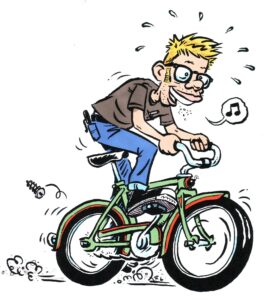
Minneapolis cartoonist Roger Lootine passed away last month. He had long been suffering from some serious health issues.
Here’s Roger’s bio from the Lambiek Comiclopedia:
Roger Lootine was born in Illinois, in 1970, as the grandson of a Dutch sea captain. He studied journalism at the University of Illinois. After that, he moved to Minnesota. He worked at various jobs and created several comics, which were published in the local student paper, rock & roll magazine Toast and The Pulse. He made his own comic series ‘Residue’, which contains a compilation of his weekly strips. His work was condemned by the Catholic Defense League for its blasphemic use of Christ in comics. R. Lootine can be found regularly at Critical Mass, the famous monthly bike ride through Minneapolis during rush hour. Although local police would love to catch up with him, he likes to steer clear of the law.
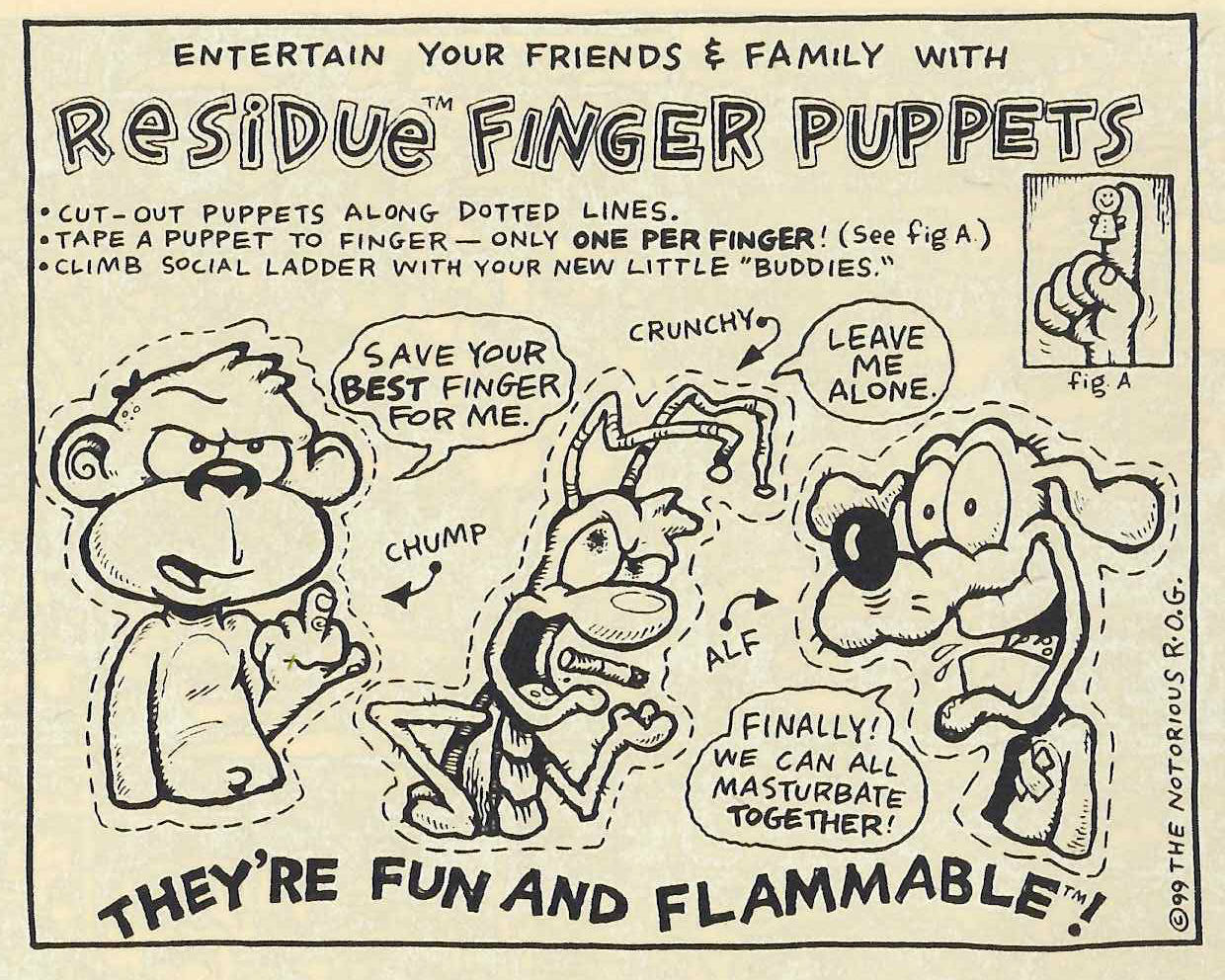
Roger was the first local cartoonist I was aware of when I moved to the Twin Cities back in 1999… I ran across the first issue of his comic Residue in an uptown coffee shop. I was immediately impressed with his art and humor, and felt an affinity for it stylistically… Roger and I both favor the meaty line, and we both often use it to render cartoon monkeys. He was then a weekly contributor to The Pulse of The Twin Cities (he had previously been a regular at the Minnesota Daily), and it was a treat to follow Residue comics there every week.
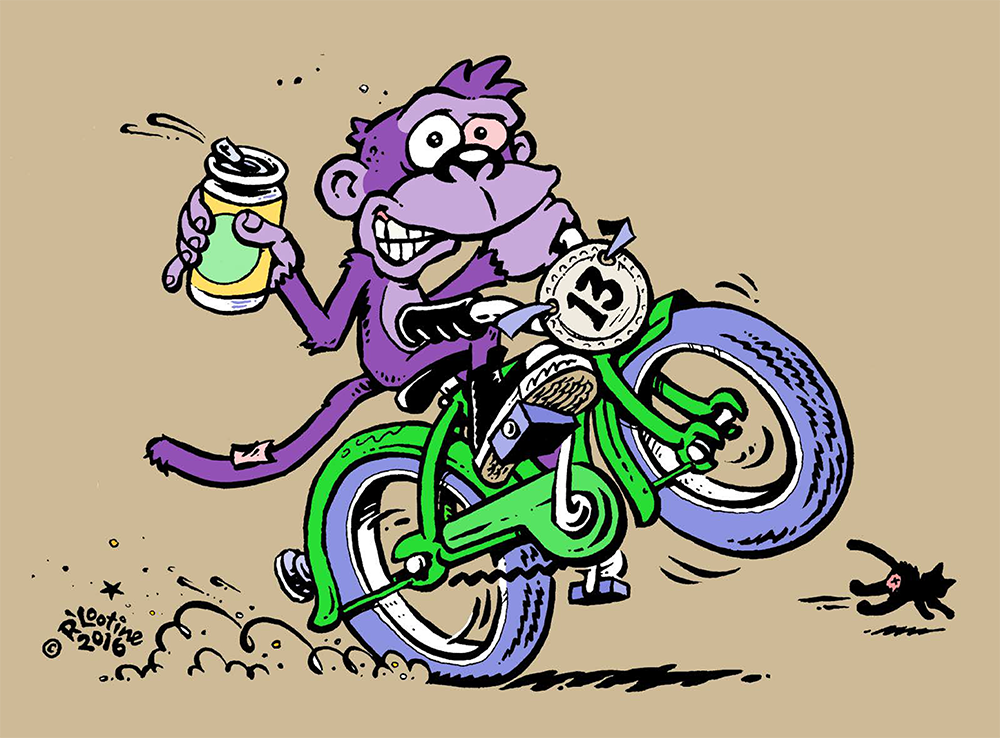
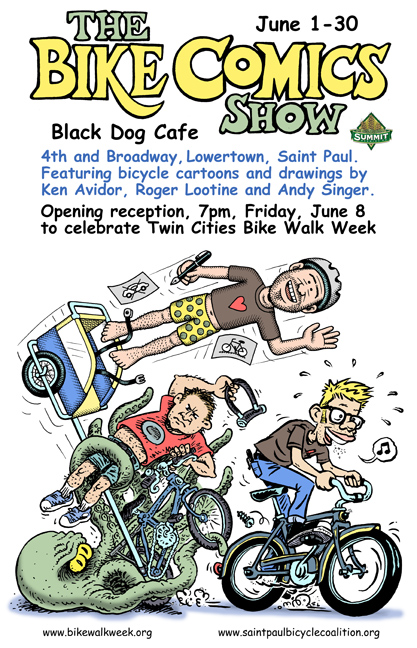
I was delighted to meet Roger when he showed up with Ken Avidor and Andy Singer at the very first Cartoonist Conspiracy meeting back in 2002… a triumvirate of Twin Cities bike-activist/cartoonists (they had more than one gallery show of their bike-related comics together). Roger was friendly and cranky and hilarious.
Roger’s cartooning output had slowed down in recent years (at least as far as what he printed)… I would guess it was probably due to the disappearance of his regular newsweekly gig combined with declining health. Roger was one of the artists featured in the Minnesota Historical Society’s book Superheroes, Strip Artists and Talking Animals written by Britt Aamodt. His section concludes:
“I have a love/hate thing with cartooning. When I start a project, everything else falls to the side. I don’t eat well. I don’t exercise. My phone gets lost in a pile.” But would he ever give up cartooning? Nope, Lootine says, “What else would I do?”
Roger contributed to a number of Cartoonist Conspiracy projects, including Lutefisk Sushi Volumes A and C, Big Funny, and, most notably, as the cover artist for Alley Cat, a book we put together when another biking cartoonist pal of ours, Eric Lappegard passed away. Hopefully Roger and Eric will have some awesome evening bike rides together in cartoonist Valhalla, or wherever it is cartoonists go when they croak.
Roger left the planet as he lived on it… on his own terms. Having had lifelong heart issues, which included childhood heart surgery, Roger had a pacemaker installed at some point. As I hear it, he really didn’t like the pacemaker and the compromises that came with it, so he insisted on having it removed, obviously against doctor recommendations.
A rare image-free post from Roger’s blog in early July 2009:
On Independence Day, we rode the trail along the Mississippi River, through the woods, under the moon, surrounded by fireflies and peering critters’ eyes.
Also, some ramblings on Freedom™:
We are as free as our willingness to submit to arbitrary rules.
We are as free as the amount of humiliation we will endure.
We are as free as the best lawyer we can afford.
We are as free as our skin pigment allows us to be.
We are as free as the home we can afford.
We are as free as the food we can afford.
We are as free as the medical care we can afford.
We are as free as the quality of life we can afford.
If you didn’t know Roger… you can still kind of get to know him from his comics. He put a whole lot of himself in them. Roger kept a blog where you can read a bunch of them. There was also a Residue Facebook site you can see here.
I’ve also bootlegged all my copies of his ongoing series Residue (I’m unfortunately missing Residue issue #5… if anyone out there has a copy, I’d love to scan it and add it). You can download the individual issues below, or download everything in a zip file by clicking on the below offensive cartoon I’ve drawn in Roger’s memory.
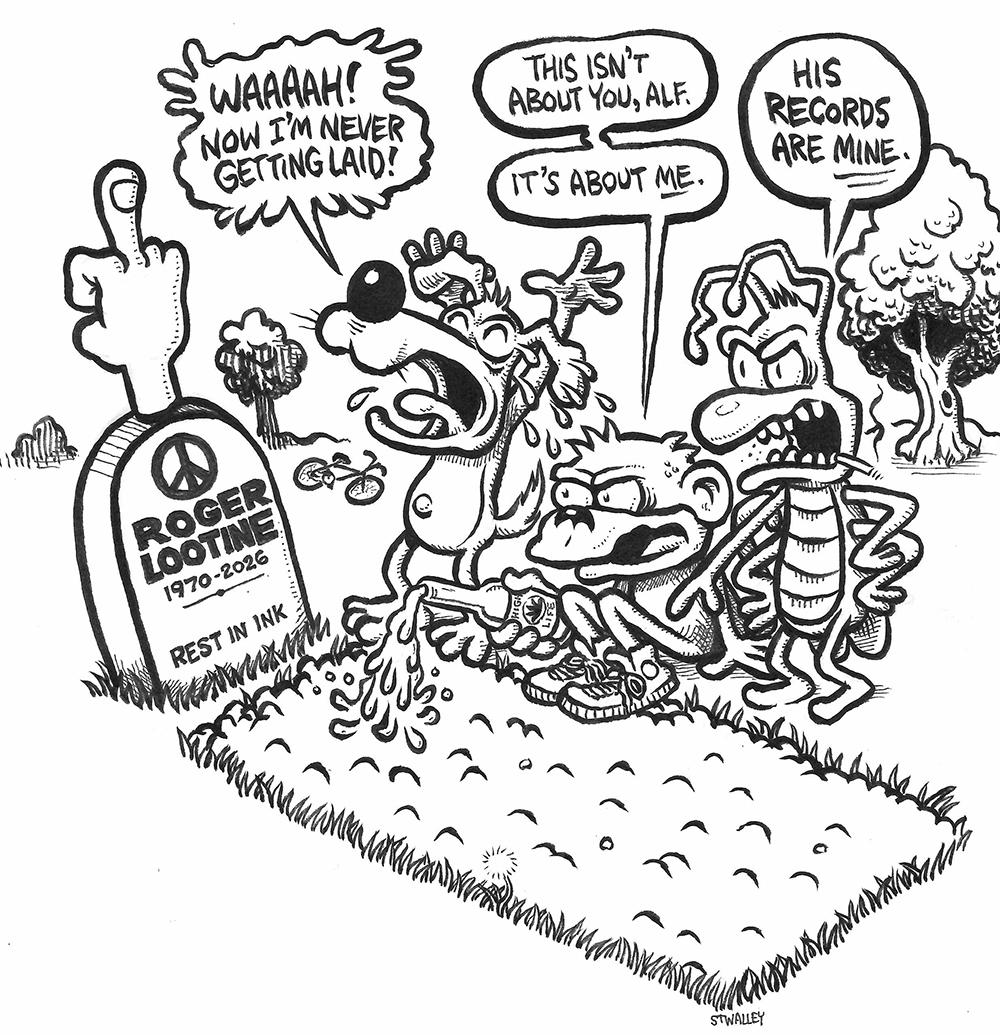
Residue SPX 1999 Special Promo
Residue Comics Dot Com Context-Free Image Dump
Residue Comics Facebook Site Context-Free Image Dump
Additional Roger Lootine Miscellany
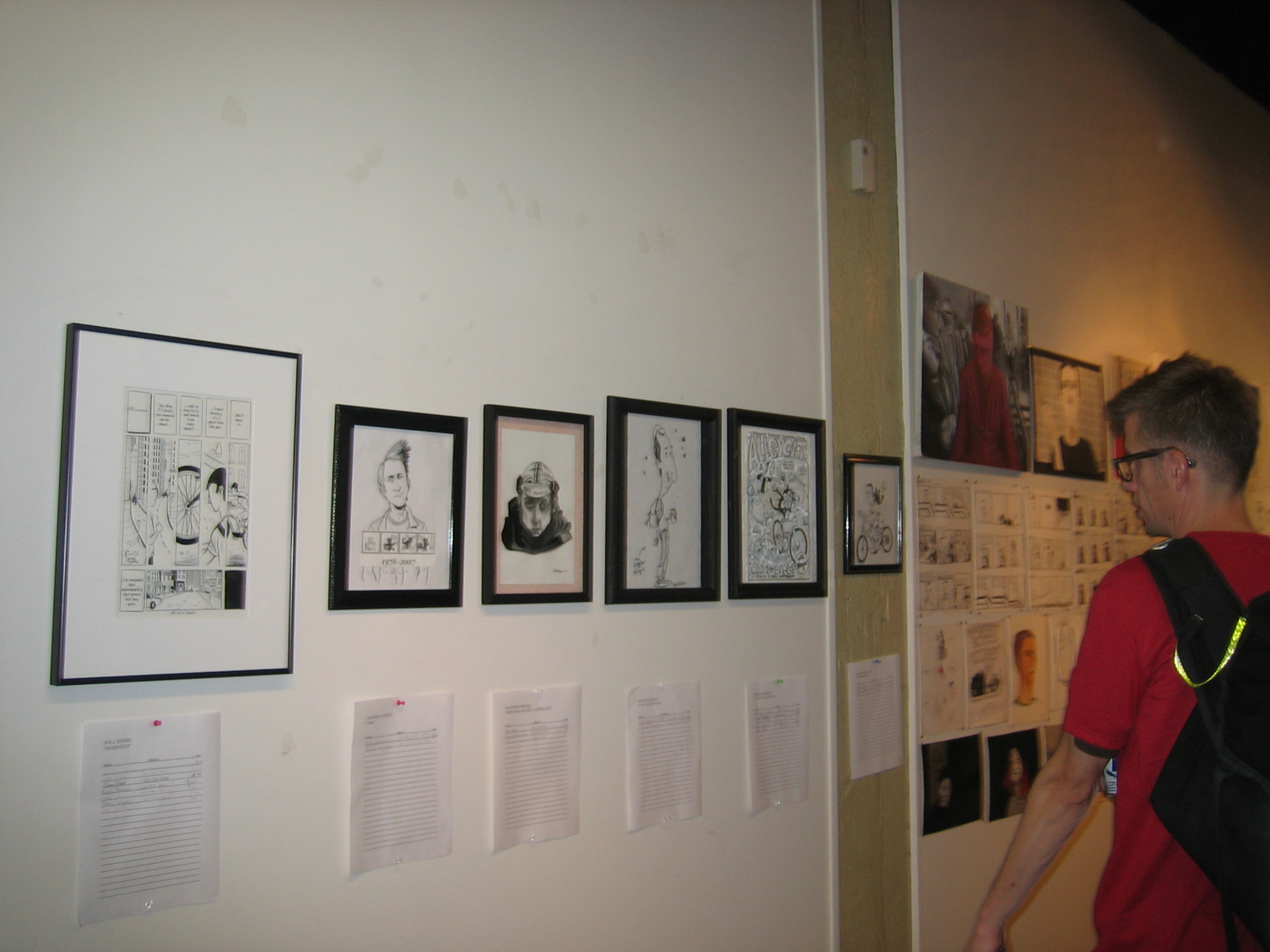
There is a Facebook group to remember Roger here. It sounds like they are organizing a memorial bike ride sometime in mid or late August. I also hear rumor there will be a gallery show of his art at some point soon. I’ll post more info here when I have it.
Also, The Cartoonist Conspiracy will be doing a “Bike Monkey” comic jam in honor of Roger at our next monthly comic jam on September 3rd 6:30PM at Lake Monster Brewing in St. Paul. If you want to participate in that but can’t attend in person, feel free to send me a panel to include (info(at)cartoonistconspiracy.com) and I’ll get it stapled into the jam somewhere.
Our good friend Jamie (Schumacher) Kalakaru-Mava wrote the below rememberance of Roger:
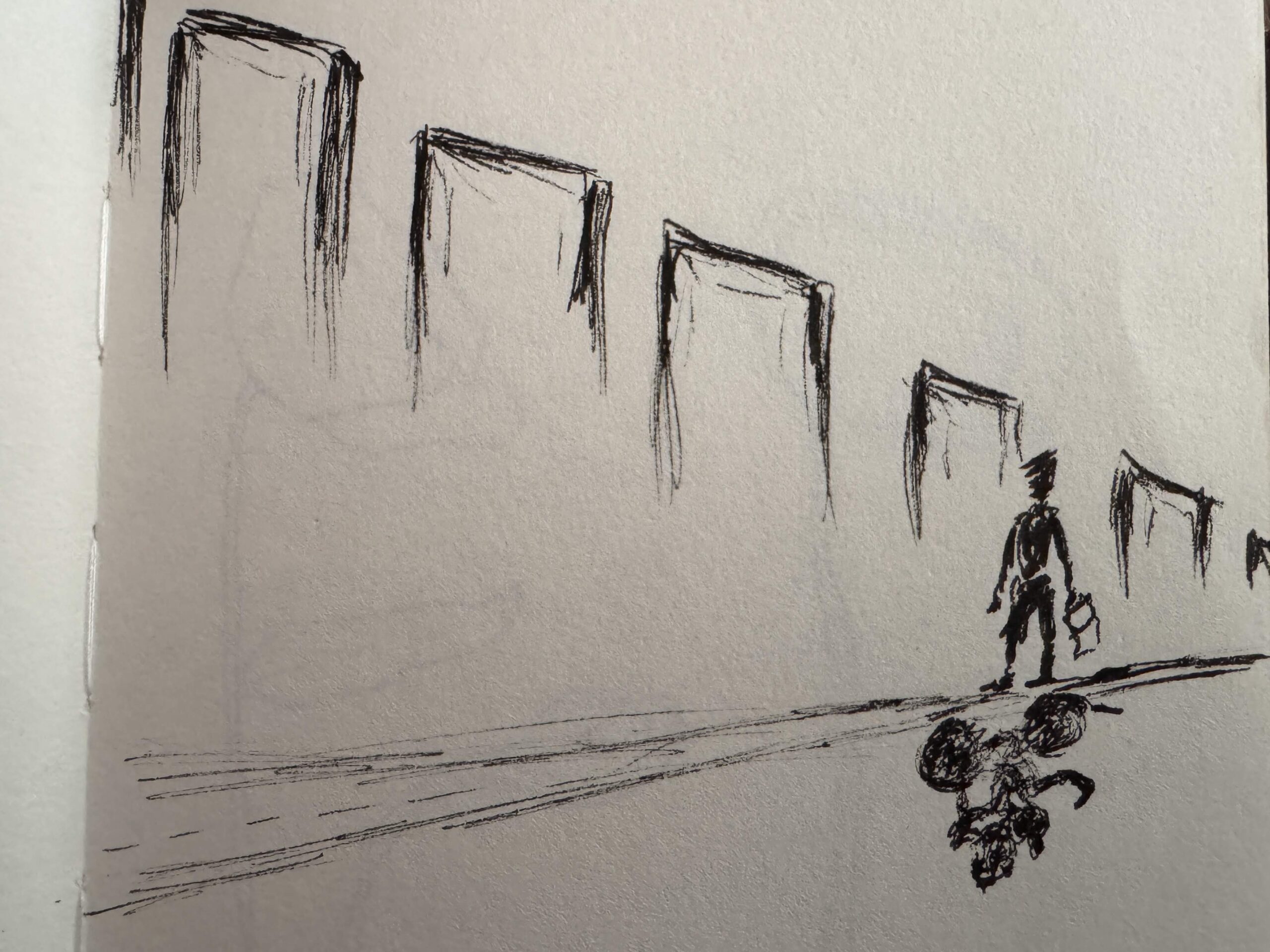
Spare Keys.
We talk a lot about creative connectors. How artists build bridges to connection, understanding, community.
We talk less often about how living in a creative brain can beget a painful kind of aloneness, also. And this kind of aloneness takes many forms.
A principled aloneness might sever ties with certain people or platforms due to their toxicity. A self-inflicted cleft cuts you off from the group or the given platform (many of which pose as connection tools but are really just three ads in an algorithmed trenchcoat.) Still, who has phone numbers anymore?
It can be a neural aloneness. Neurodivergence can do that, instill a kind of aloneness where your brain is working over time, all by itself. So active, so many thoughts, pouring over all the things that make sense and don’t. Too much for your own brain, certainly too much for other people to handle.
A drive that can fuel you, a fuel that can drive partners and friends away with its too-muchness.
Artists can collaborate, but creativity is often a solitary process.Writing alone. Drawing alone. Putting all those messy thoughts into less-messy somethings. There’s a fine line between unrecognized genius and recognized madness.
It’s hitting me a lot lately, too, the borderline madness. I’m up late and I can’t sleep. I wake up sad about a thing that’s really something else, something that’s not the thing that’s really upsetting me. (“It’s not the Iranian yogurt.” IYKYK.) In my late night madness I search for clues, my brain lifts question after question. And with each unanswered piece of the puzzle, the reality sets in that digs the knife a little deeper. A reality in which I miss my friend deeply, I’ve missed my friends for so long from principled semi-self-isolation, and now, at least in one instance, it is too late.
I opened an art gallery in 2004, a space for creative isolates to particle up together. It wasn’t a fancy space, we had weird and unusual shows and political commentaries, and we experimented with organizational models and other creative not-so-nonsense. I wanted to create a community space where people could connect and we could show artwork not based on who was fancy and had the most clout, but on what we could more effectively say as a collective whole. Our first show was the Art of War, a community response to the Bush-led war in Iraq.
I met Roger when I curated our first annual Bike Art show. It was, from all I remember, everything it should have been – from a live reading of John Heimbuch’s “10 Speed Revolution” (subtitled Anarchy! Bicycles! Punk!) to an art-a-whirler passing out drunk against the plate glass window separating the gallery from the office. I met Roger in the traditional way one meets friends: a fan of the Residue comics I saw online, I found his PO Box mailing address and sent him a letter in the paper mail (paper mail!!!), and waited. And waited. And waited.
And then I heard back! Roger, this awesome published artist, this uber talented COMIC ARTIST who had his work IN A PROFESSIONALLY PUBLISHED PAPER wanted to be in my little art show. And then in the months that followed, I learned the better secret, the best kept secret of the Twin Cities: that like me, Roger was just another nerd in search of connection. Also: though not actually terribly older than me in years, he was also already somehow seventy five and a grumpy old coot.
We hung out regularly at the gallery – not just for the annual bike art shows, but at openings and events, too. At group rides, at cartoonist connections. Entirely volunteer-run, board members and curators would hold our open hours and events. And Roger, a mainstay, would occasionally hold gallery hours too. So much so that he eventually had his own key to the gallery. When we moved to a new building, we made sure we also made a key for the folks that needed it. Among the rotating cast of board members and interns, two people always had a key until we no longer had a gallery: me, and Roger.
What follows is an excerpt from “It’s Never Going To Work,” a book I wrote about the gallery and that time. This is called: How to balance while climbing.
Minneapolis, MN — August 2006We tidied up after the Guerrilla Art exhibit opening and sat around for awhile talking. Roger Lootine was one of the featured artists, displaying zines and artwork from his cheeky and politically savvy Residue Comics series. Eventually it was me and Roger left, and we decided to continue our conversation about politics and art on the rooftop adjacent to the gallery. We headed to the back storage room, dusted the rust off the handle, opened the window, and climbed out to our roof.
“You get a decent view of the Northrup King Building from here,” I said. “The grain factory too, or whatever that is. All I know is that sometimes in the winter, it totally smells like cereal!”
“Does that go to the other roof?” he asked, pointing up.
“Yeah, but I haven’t been up there. The reliability of that ladder freaks me out a little.”
“C’mon, let’s go!” he said cheerfully. (My friends are far more fearless than I am.)
And so we climbed, me much more cautiously.
“If you keep three points on at all times you’ll be way more secure as you work your way up,” he advised, quite correctly. And just like that, little by little, I found my way up the ladder all the way to the next rooftop and over once again. A killer view of downtown, a killer view of Northeast, and a kindred spirit to share it with. It doesn’t get much better.
A few years later I took up bouldering and rock climbing, through which I learned even more about balancing. Even when you’re strapped in with a reliable belayer to help secure you, there’s always the hope you don’t fall. So you make sure your footing is steady and your grip is strong before you make the next move up the rock face. And sometimes it isn’t up — it’s sideways or even down and back up another way. Regardless of whether you’re working your way up, down, or over, balance is key if you want to make it out intact.
It has taken me years to learn how to do this with any small semblance of grace. It’s learning to say no politely, while still being as helpful as possible. It’s learning to take time for myself and my family unapologetically, and being supportive when others do the same. It’s making sure my footing is sure and my balance is stable before I take the next step, much less help somebody else with taking theirs.
The best part of the gallery wasn’t always the exhibitions themselves: it was the edges, the after, the in-between spaces where I was able to connect with artists and colleagues like Roger. One of the most important lessons I learned from them was to not only check my footing, but also to trust myself.
Note to self: call Roger, say hi.
___________
I can’t remember the last time I saw Roger in person.
Before I left social media, I tried to make sure I had all my contacts in tact, telling myself I was simply cutting the middleman of connection. Fuck Zuck, right? And in the midst of work, family, teaching, and a federal occupation, I’m not about to entrust anything to the untrustworthy. Not to mention the impact on my focus, my energy, my own mental health.
And it worked… mostly. (I still think we’ll be saying about social media what we said about cigarettes – we knew it was bad, but the corporations went about it anyway. ANYWHO.)
In the wake of the news, I have been going through old folders, old albums, the internet wayback machine, hunting for photos lost to time and corporate transfers. Phanfare, remember phanfare? Free subscriptions for nonprofits -until they sold the company, and all the archives disappeared. In my sadness I did what people often do, hunting for those traces, the last connection points.
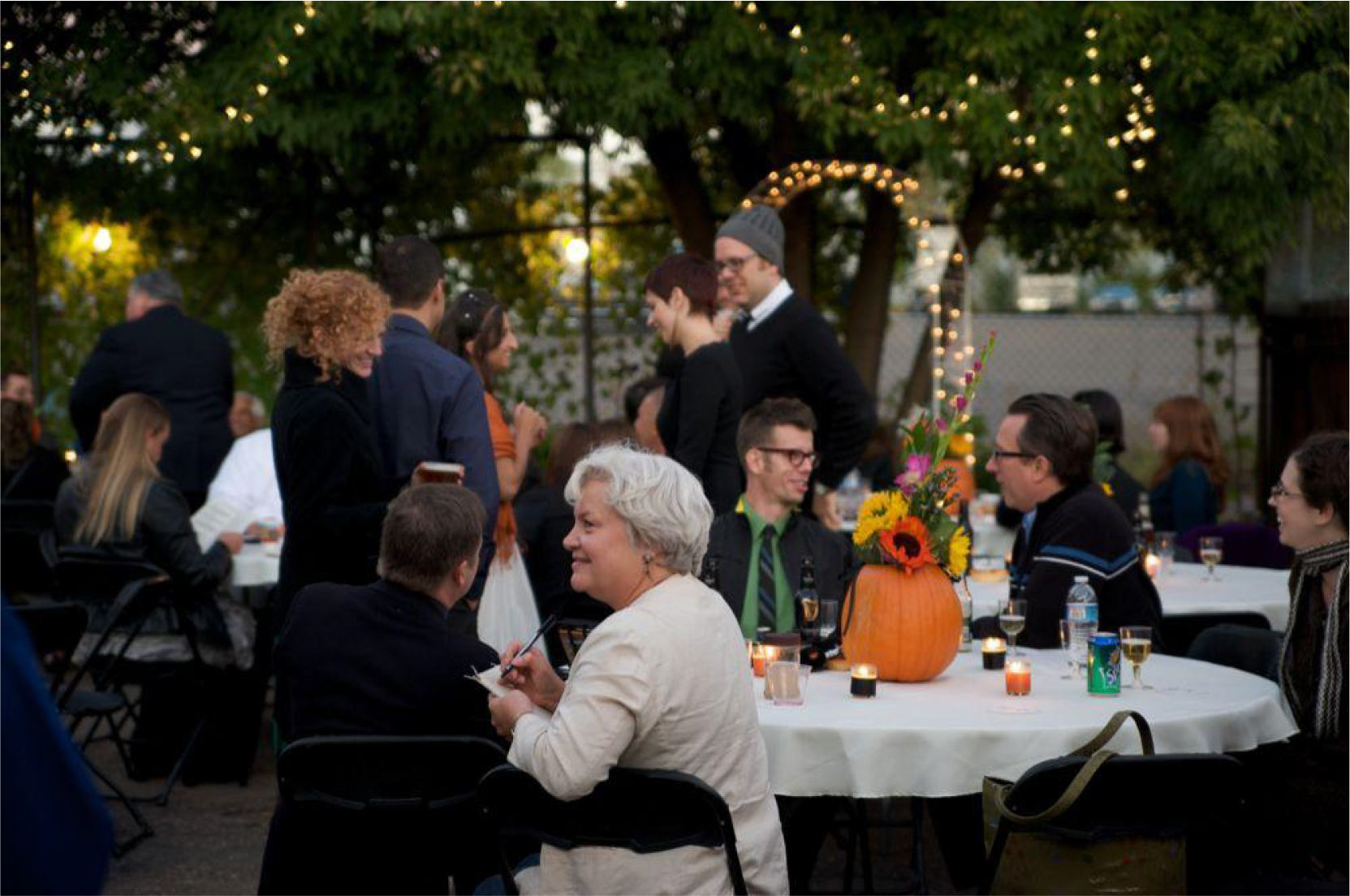
I found some images from the bike art show, of course. I found some photos of random gallery hangs. I found a photo from our wedding! Roger looked so handsome, and so happy.
And stumbling upon that image gave me a pang of sadness, too. Not just at the loss, but on the event itself, and where I think I went wrong. I think when we get married, we get it a bit backwards. Or at least, we do the math wrong on the equation. The couple invites and welcomes guests, and I do remember thinking about it as forward-thinking. “This is our circle, these are our people, these are the family and friends who believe in us and will hold us accountable to ourselves and hold us up when things are hard.”
But that’s only one direction, right? As we build our lives, our family, our future – are we making sure we’re not walling ourselves off, unintentionally?
Among the things Roger and I had in common, was – let’s say: utilizing effective ways to slow down the constant whirring of the thinking machine.
And last night, after I had slowed down my overactive thinking machine to the speed of normalcy, I was once more rooting through more archives. Searching, searching. And I found myself thinking… “isn’t this just what memory is? What I’m doing right now, manually? Memory is images and bits of information sorted and saved, lost and forgotten.”
We think we have to keep our photos and documents organized, we have to capture the moment, and then sort these things neatly into clearly labeled and findable folders. Okay maybe the hyper organization bit is a me thing. But even the most organized folder, the best photo captured, means next to nothing without the *memory.* And the memory is just that connection point, the bridge between one person to another. Me taking that photo of you on a trip we were on, together. Friends hugging, or drawing together, on a group ride. What is the loss of me not finding a photo, a photo that connects moment to memory, to say “I was there, then, with my friend Roger, and we had a time.”
In that moment I realize am not desperate for that photo I can’t seem to locate. I am desperate for the connection that’s irreparably and forever gone. The friend I will never get back, a connection severed because I was too caught up in the messiness of life that I wasn’t tending enough to relationships that desperately needed tending.
I remember talking about work, and Roger was telling me about his job at the time. It wasn’t perfect, but a job’s a job. Do you remember the art school instruction ads, where you draw the little turtle or the little pirate? I remember Roger telling me about one of the more rewarding parts of that otherwise not-perfect gig. The Twin Cities are very connected, very creative, and we have lots of options here. It might seem silly to us to mail in the drawing – especially now. But in the 00s, for a kid in a rural area, that was a lifeline. Roger – whose values were cynical, cantankerous, and right 99% of the time – wasn’t thinking about how spec art is bad, how corporations are corrupt, and how the program was a grift. Well, okay he was probably thinking about those things. But he was also thinking about that kid, many of whom came from rural areas with few options, for whom this activity, this creative kindling, was a lifeline. An opportunity for connection.
And I think, in that way, Roger continues to hold a key.
We don’t have to agree on everything, or be perfect in how we show up. We can be grumpy friends and still be friends. And we can be honest about how hard it is to caregive for those with depression, those who are struggling, which is so many of us in this moment.
But the key to our mutual survival are these relational connections we have with each other. The past six years in this community haven taken so much from us – but they have also reinforced the importance of connection. We can’t lose the thread of what we can be for one another.
I am so sad. And I am so angry at myself, that I was not able to show up the way I should have for my sweet, kind, grumpy old man. My friend Roger, who once was prolific, creative, and always up for an adventure. (But a cheap and close one, preferably.) Roger, who could pinpoint the societal problem with the humour and accuracy only available to the most genius of cynics. My friend Roger who taught me to balance while climbing, and so much more.
I will miss you so much, and I’m so sorry.
RIP Roger…
Growing up in suburban MPLS. Roger was on of the first people who was in the Daily and making zines and making me realize locals can do it too.
I was beyond thrilled when not even a decade later he was someone who could point me out in a police line up, not that he would — fuck the pigs.
I haven’t seen Roger –or many of the people who made my 20s and 30s feel packed to the gills with wonderful humans– in forever, but the memory of him in his 2000s era bike courier fashion sucking down a heater with his giant smile will always be with me.